
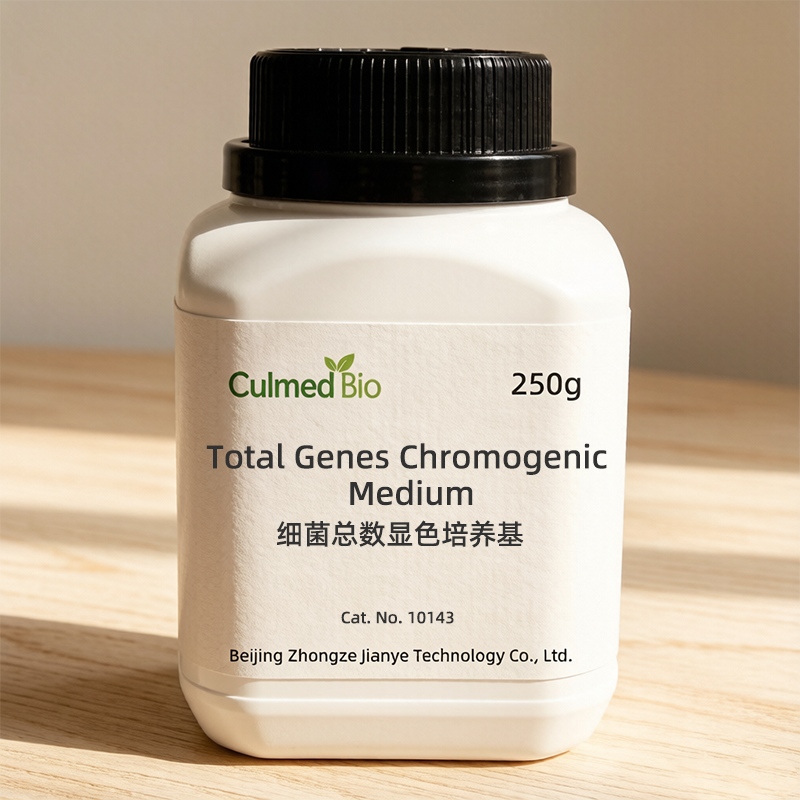
This Total Bacterial Count Chromogenic Medium is a dehydrated powder formulation designed for the rapid detection and enumeration of total viable bacteria in food, water, and environmental samples. Unlike conventional general-purpose media that require 48 hours or more for colony development, this chromogenic medium enables visible red colony formation within 24 hours, significantly accelerating routine microbiological testing workflows.
The medium contains a chromogenic substrate that is cleaved by bacterial enzymes, producing a red or light red color in growing colonies. This color reaction makes colonies highly visible against the medium background, reducing the risk of missed colonies and improving counting accuracy. Occasional colonies may appear colorless or white; these should still be included in the total count as they represent viable bacteria that did not express the chromogenic reaction .
The 250g bottle format is suitable for laboratories preparing their own plates and is ideal for food safety testing, water quality monitoring, and environmental hygiene verification.
Intended Use
- Rapid enumeration of total bacterial count (total viable count) in food and beverage samples.
- Water and wastewater microbiological testing.
- Environmental monitoring and hygiene verification.
- Quality control in food processing and pharmaceutical facilities.
- Research and educational laboratory applications.
Composition (per Liter, as Dehydrated Basis)
- Recombinant Peptone: 8.00 g
- Comprehensive Nutrients: 2.40 g
- Chromogenic Reagent: 0.10 g
- Agar: 13.00 g
- Final pH: 7.0 ± 0.1 at 25°C
Interpretation of Results
- Red or light red colonies: Typical target bacteria; count all such colonies.
- Colorless or white colonies (occasional): Also viable bacteria; include in the total count.
- No growth: No detectable bacterial contamination under the test conditions.
Storage and Shelf Life
- Format: 250 g/bottle, dehydrated powder.
- Shelf Life: 2 years from date of manufacture.
- Storage: Store in a dry, dark place at 2–8°C. Keep tightly closed to prevent moisture absorption.
Preparation and Use:
- Medium Preparation: Suspend 23.5 g of the dehydrated medium in 1,000 mL of distilled water. Heat with frequent agitation and bring to a boil for approximately 1 minute until completely dissolved. Do not overheat.
- Sterilization: Autoclave at 121°C for 15 minutes. Cool to 45–50°C before use.
- Inoculation: For the pour plate method, transfer 1 mL of the prepared sample dilution into a sterile Petri dish and add approximately 15 mL of the tempered medium. Mix gently and allow to solidify. Alternatively, use the spread plate method according to your standard operating procedure.
- Incubation: Incubate the plates in an inverted position at 35 ± 1°C for 48 ± 2 hours (or 24 hours for rapid results, depending on sample type and validation).
- Enumeration: Count all red, light red, and occasional colorless colonies. Record the total bacterial count.
Q: What is the advantage of using a chromogenic medium for total bacterial count?
A: Chromogenic media produce colored colonies through an enzymatic color reaction, making colonies easier to see and count. This medium allows red colony development within 24 hours, reducing turnaround time compared to conventional media that typically require 48 hours.
Q: Why should colorless colonies also be counted?
A: Not all bacteria express the enzyme that produces the chromogenic reaction. Occasional colonies may appear colorless or white, but they are still viable microorganisms and must be included in the total bacterial count to avoid underestimation .
Q: What is the recommended incubation condition?
A: The standard incubation condition for this medium is 35 ± 1°C for 48 ± 2 hours. For rapid results, 24-hour incubation may be used depending on sample type and laboratory validation.
Q: How should I prepare the medium?
A: Suspend 23.5 g of the dehydrated powder in 1,000 mL of distilled water, heat to boiling with agitation until fully dissolved, autoclave at 121°C for 15 minutes, and cool to 45–50°C before pouring plates.
Q: What is the shelf life and storage condition for the dehydrated powder?
A: The shelf life is 2 years from the date of manufacture when stored at 2–8°C in a dry, dark place. Keep the bottle tightly closed to prevent moisture uptake.
Q: Can this medium be used for environmental monitoring?
A: Yes. This chromogenic medium is suitable for detecting total bacterial count in environmental samples, including surface swabs and water samples, in addition to food and beverage testing.
| Product Form | Dehydrated powder |
| Package Size | 250 g/bottle |
| Peptone (Recombinant) | 8.00 g/L |
| Comprehensive Nutrients | 2.40 g/L |
| Chromogenic Reagent | 0.10 g/L |
| Agar | 13.00 g/L |
| pH | 7.0 ± 0.1 (at 25°C) |
| Colony Color | Red / light red |
| Incubation | 35 ± 1°C, 48 ± 2 h (or 24 h rapid) |
| Shelf Life | 2 years |
| Storage | 2–8°C, dry, protected from light |
| Intended Use | Total bacterial count enumeration (in vitro) |
