
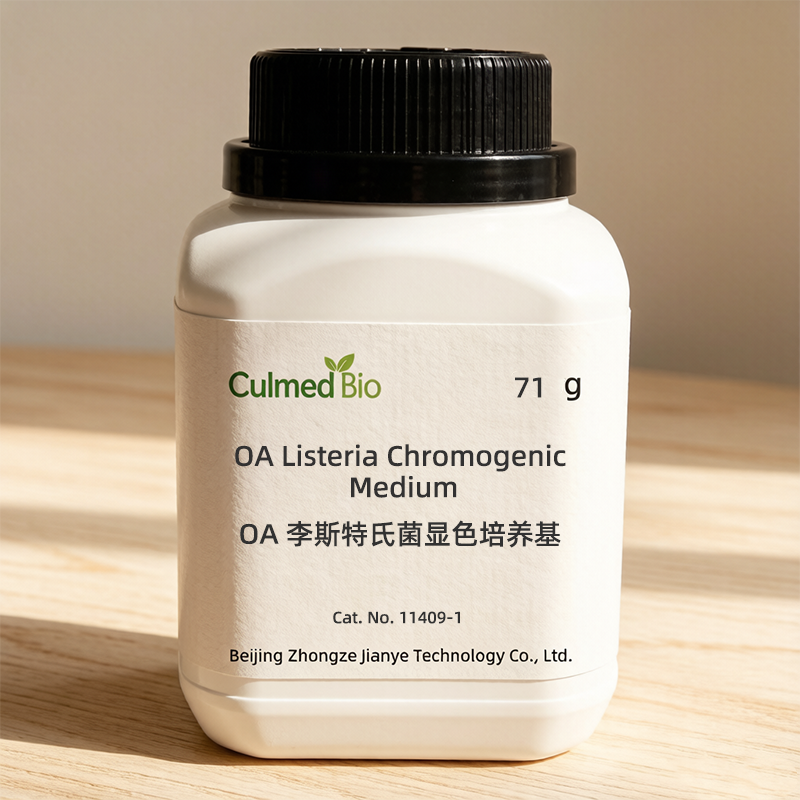
This OA Listeria Chromogenic Medium is a dehydrated powder base formulated for the rapid isolation and presumptive identification of Listeria species, including Listeria monocytogenes. The base medium follows the Ottaviani & Agosti (OA) formulation. When the appropriate selective supplements and phosphatidylinositol are added, it becomes the complete ALOA (Agar Listeria according to Ottaviani and Agosti) medium.
The medium utilizes a chromogenic substrate, 5-bromo-4-chloro-3-indolyl-β-D-glucopyranoside (X-β-Glc), which is cleaved by the β-glucosidase enzyme produced by all Listeria species, dyeing the colonies blue. The addition of L-α-phosphatidylinositol allows the detection of the phospholipase C (PI-PLC) enzyme, which is specific to pathogenic Listeria species (like L. monocytogenes and L. ivanovii). This enzyme creates a distinct opaque halo around the blue colonies, differentiating pathogenic Listeria from non-pathogenic species (which grow blue but without a halo).
The medium is highly selective due to the combination of lithium chloride and the specific antibiotic supplements (nalidixic acid, ceftazidime, polymyxin B, and cycloheximide or amphotericin B), which inhibit Gram-negative bacteria and fungi, allowing Listeria to thrive. Presumptive results are typically available within 24–48 hours.
Intended Use
- Rapid detection and presumptive identification of Listeria species, particularly L. monocytogenes.
- Microbiological testing of food and dairy products (e.g., soft cheeses, ready-to-eat meals).
- Environmental monitoring in food processing facilities.
- Food safety and hygiene verification.
- Research and educational laboratory applications.
Composition (Base Medium, per 930 mL)
- Peptone: 18.0 g
- Tryptone: 6.0 g
- Yeast Extract Powder: 10.0 g
- Sodium Pyruvate: 2.0 g
- Glucose: 2.0 g
- Magnesium Glycerophosphate: 1.0 g
- Magnesium Sulfate (Anhydrous): 0.5 g
- Sodium Chloride: 5.0 g
- Lithium Chloride: 10.0 g
- Disodium Phosphate (Anhydrous): 2.5 g
- X-β-D-Glucopyranoside (Chromogenic Substrate): 0.05 g
- Agar: 15.0 g
- Distilled Water: 930 mL
- Final pH: 7.2 ± 0.2 at 25°C
Required Supplements (Not Included / Purchased Separately)
To complete the ALOA formulation, the following supplements must be added aseptically after the base medium is sterilized and cooled:
- 0.4% Nalidixic Acid Solution: 5 mL
- 0.4% Ceftazidime Solution: 5 mL
- Polymyxin B Solution: 5 mL
- 2% Cycloheximide Solution: 5 mL (or 0.1% Amphotericin B Solution: 10 mL)
- L-α-Phosphatidylinositol Solution: 50 mL (Critical for the opaque halo reaction)
Interpretation of Results
- Blue colonies with an opaque halo: Presumptive pathogenic Listeria (e.g., Listeria monocytogenes, Listeria ivanovii).
- Blue colonies without a halo: Presumptive non-pathogenic Listeria species (e.g., Listeria innocua).
- Colorless or inhibited colonies: Non-Listeria organisms.
Storage and Shelf Life
- Format: 71 g/bottle, dehydrated powder base.
- Shelf Life: 2 years from date of manufacture (standard for dehydrated media; confirm with your supplier if different).
- Storage: Store in a dry, dark place at 2–8°C. Keep tightly closed to prevent moisture absorption
Q: What is the difference between OA medium and ALOA medium?
A: The OA (Ottaviani & Agosti) formulation is the base medium. ALOA (Agar Listeria according to Ottaviani and Agosti) is the complete medium created by adding specific selective supplements and L-α-phosphatidylinositol to the OA base.
Q: Why is L-α-phosphatidylinositol supplement necessary?
A: It is the substrate for the phospholipase C (PI-PLC) enzyme produced by pathogenic Listeria (like L. monocytogenes). The breakdown of this substrate creates the opaque halo around the blue colonies, which is critical for differentiating pathogenic from non-pathogenic Listeria.
Q: How do I differentiate Listeria monocytogenes from other Listeria species?
A: L. monocytogenes (and L. ivanovii) produce blue colonies surrounded by a distinct opaque halo due to PI-PLC activity. Non-pathogenic species (like L. innocua) produce blue colonies without a halo.
Q: How do I prepare the medium?
A: The base powder is dissolved in water, boiled, and autoclaved. After cooling to 48–50°C, the selective supplements and phosphatidylinositol are added aseptically, mixed, and poured into plates.
Q: What is the shelf life and storage condition for the dehydrated powder?
A: The shelf life is 2 years from the date of manufacture when stored at 2–8°C in a dry, dark place. Keep the bottle tightly closed.
Q: How should I dispose of the plates after use?
A: This is a single-use product. After use, plates must be disposed of as biohazardous waste. Autoclave the plates before final disposal.
