
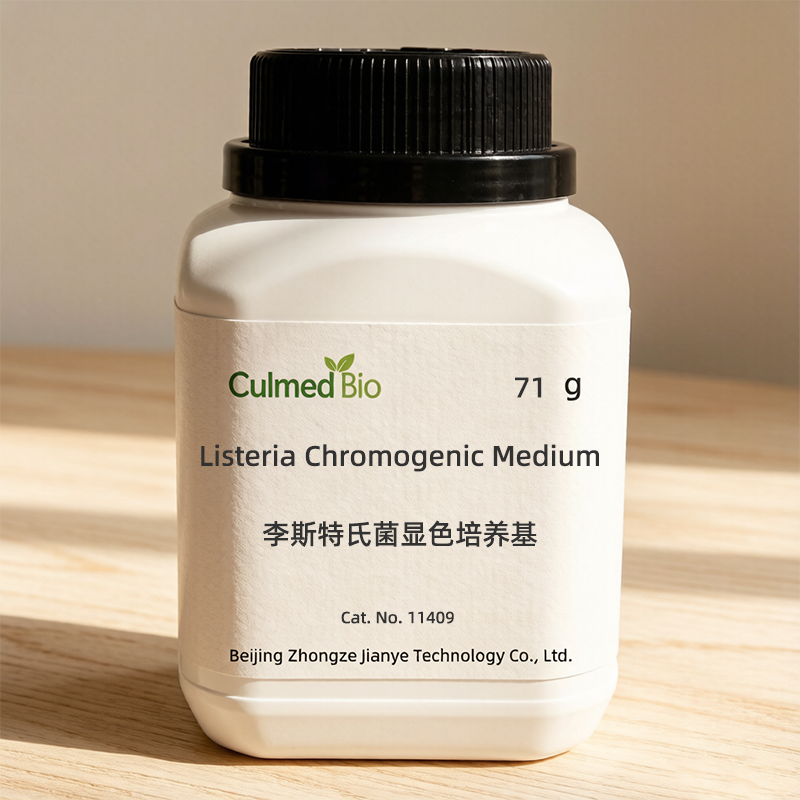
This Chromogenic Listeria Agar (CLA) is a complete dehydrated powder kit designed for the rapid isolation and presumptive identification of Listeria species, including Listeria monocytogenes. The kit includes the base medium powder, specialized additives (A, B, and C) required for selective and differential activity, and glass beads for homogenization during preparation.
The medium utilizes chromogenic substrates that are cleaved by enzymes produced by Listeria species, dyeing the colonies a distinct blue. The specific formulation in this kit causes Listeria colonies to also produce a precipitation zone (opaque halo) around the colony. This reaction allows for the presumptive identification of Listeria species directly on the plate within 48 hours.
The medium is highly selective. As demonstrated in the quality control data, it completely inhibits Escherichia coli and Salmonella typhimurium, while allowing Listeria species to grow robustly. Staphylococcus aureus may grow but appears yellow without a precipitation zone, allowing for easy differentiation.
Intended Use
- Rapid detection and presumptive identification of Listeria species.
- Microbiological testing of food and dairy products (e.g., soft cheeses, ready-to-eat meals, meat).
- Environmental monitoring in food processing facilities.
- Food safety and hygiene verification.
- Research and educational laboratory applications.
Composition (per 1000 mL, as Dehydrated Basis)
- Recombinant Peptone: 30.0 g
- Comprehensive Nutrients: 26.0 g
- Chromogenic Reagent: 1.5 g
- Final pH: 7.3 ± 0.2 at 25°C
(Note: The final medium includes the dissolved contents of Additives A, B, and C).
Kit Contents (配套试剂)
- Additive A (添加剂 A): 1.2 g/bottle × 5 bottles/box
- Additive B (添加剂 B): 1 mL/ampoule × 5 ampoules/box
- Additive C (添加剂 C): 1 mL/ampoule × 5 ampoules/box
- Glass Beads (玻璃珠): 1 pack/box
Quality Control (Growth Performance)
Validated at 36 ± 1°C for 48 hours:
- Listeria monocytogenes ATCC 19114 (30–100 CFU): Growth rate ≥85%; blue colonies with a precipitation zone.
- Listeria innocua ATCC 33090 (30–100 CFU): Growth rate ≥85%; blue colonies with a precipitation zone.
- Listeria ivanovii CICC 21663 (30–100 CFU): Growth rate ≥85%; blue colonies with a precipitation zone.
- Listeria seeligeri ATCC 51335 (30–100 CFU): Growth rate ≥85%; blue colonies with a precipitation zone.
- Staphylococcus aureus ATCC 25923 (streak): Yellow colonies, no precipitation zone.
- Escherichia coli ATCC 25922 (10⁴–10⁵ CFU): Completely inhibited; no growth.
- Salmonella typhimurium ATCC 14028 (10⁴–10⁵ CFU): Completely inhibited; no growth.
Physicochemical Properties
- Appearance: Powder – light yellow; Prepared plate – white, opaque.
- Moisture (Powder): ≤5%
- pH: 7.3 ± 0.2 (at 25°C)
- Gel Strength: 550–650 g/cm²
Storage and Shelf Life
- Format: 71 g/bottle (base powder) + supplements kit.
- Shelf Life: 2 years from date of manufacture (standard for dehydrated media; confirm with your supplier if different).
- Storage: Store in a dry, dark place at 2–8°C. Keep tightly closed to prevent moisture absorption.
Q: What is Chromogenic Listeria Agar used for?
A: It is used for the rapid isolation and presumptive identification of Listeria species in food and environmental samples. The chromogenic reaction produces blue colonies, and the specific formulation creates a precipitation zone around the colonies.
Q: How do I interpret the colony appearance?
A: Listeria species appear as blue colonies with a precipitation zone (halo). Staphylococcus aureus may grow but appears yellow without a halo. Gram-negative bacteria like E. coli and Salmonella are completely inhibited.
Q: How quickly can results be obtained?
A: Presumptive Listeria colonies appear after incubation at 36 ± 1°C for 48 hours.
Q: What is included in the kit?
A: The kit includes 71 g of base powder, 5 bottles of Additive A (1.2 g each), 5 ampoules of Additive B (1 mL each), 5 ampoules of Additive C (1 mL each), and a pack of glass beads.
Q: How do I prepare the medium?
A: The process involves separately preparing Additive A with water and glass beads, boiling and autoclaving the base medium, and then aseptically combining them with Additives B and C after cooling to 50–55°C before pouring plates.
Q: How should I dispose of the plates after use?
A: This is a single-use product. After use, plates must be disposed of as biohazardous waste. Autoclave the plates before final disposal.
