
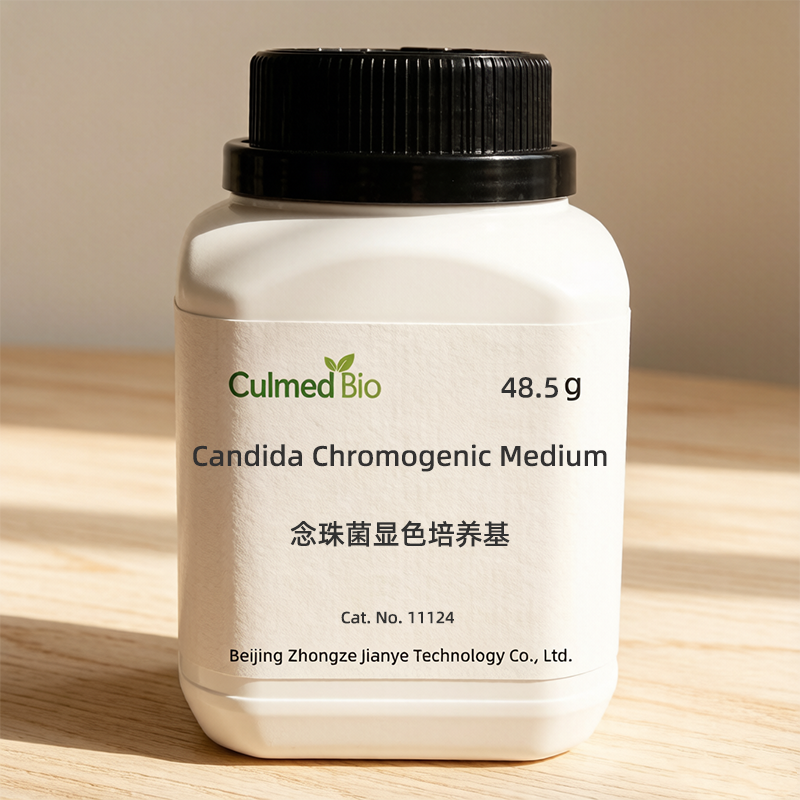
This Candida Chromogenic Medium is a dehydrated powder formulation designed for the rapid isolation, detection, and differentiation of clinically and industrially important Candida species. The medium utilizes specific chromogenic substrates that are cleaved by species-specific enzymes, producing distinct colony colors that allow presumptive identification without the need for extensive biochemical testing.
The color differentiation is as follows:
- Candida albicans: Green or grass-green colonies.
- Candida krusei: Pink, light pink, or pink-purple colonies.
- Candida tropicalis: Blue, dark blue, blue-grey, or steel blue colonies.
- Candida glabrata: Purple or light purple colonies.
- Other Candida species: Generally white colonies.
This color-coded differentiation enables laboratories to rapidly screen for the most common Candida pathogens, including C. albicans, C. krusei, C. tropicalis, and C. glabrata, within 24–48 hours. The medium contains a proprietary “Nystatin” or similar selective agent (as listed in the composition) to inhibit the growth of Gram-negative bacteria, allowing Candida species to grow while suppressing competing flora.
Intended Use
- Rapid isolation and presumptive identification of Candida species.
- Clinical microbiology testing (e.g., vaginal swabs, respiratory samples).
- Environmental monitoring in healthcare and pharmaceutical facilities.
- Food and beverage microbiological testing.
- Research and educational laboratory applications.
Composition (per 1000 mL, as Dehydrated Basis)
- Nutrient Elements: 13.1 g
- Selective Agent (e.g., Nystatin): 0.1 g
- Chromogenic Reagent: 20.3 g
- Agar: 15.0 g
- Final pH: 6.3 ± 0.2 at 25°C
Quality Control (Growth Performance)
Validated at 25 ± 1°C for 24–48 hours:
- Candida albicans CMCC(F)98001 (30–100 CFU): Growth rate ≥85%; green or grass-green colonies.
- Candida glabrata ATCC 15126 (30–100 CFU): Growth rate ≥85%; purple or light purple colonies.
- Candida tropicalis ATCC 13698 (30–100 CFU): Growth rate ≥85%; blue, dark blue, blue-grey, or steel blue colonies.
- Candida krusei ATCC 14243 (30–100 CFU): Growth rate ≥85%; pink, light pink, or pink-purple colonies.
- Escherichia coli ATCC 25922 (10⁴–10⁵ CFU): Inhibited (no growth).
Physicochemical Properties
- Appearance: Powder – white or light yellow; Prepared plate – colorless, no visible impurities.
- Moisture (Powder): ≤6%
- pH: 6.3 ± 0.2 (at 25°C)
- Gel Strength: 450–550 g/cm²
Storage and Shelf Life
- Format: 48.5 g/bottle, dehydrated powder.
- Shelf Life: 2 years from date of manufacture (standard for dehydrated media; confirm with your supplier if different).
- Storage: Store in a dry, dark place at 2–8°C. Keep tightly closed to prevent moisture absorption.
Q: What is Candida Chromogenic Medium used for?
A: It is used for the rapid isolation and presumptive identification of clinically important Candida species, allowing differentiation based on specific colony colors.
Q: How do I interpret the colony colors?
A: C. albicans appears green, C. krusei appears pink or pink-purple, C. tropicalis appears blue, and C. glabrata appears purple. Other Candida species typically appear white.
Q: How quickly can results be obtained?
A: Presumptive identification can be made after incubation at 25 ± 1°C for 24–48 hours. Some slower-growing species may require up to 72 hours.
Q: How do I prepare the medium?
A: Weigh 48.5 g of powder, add to 1,000 mL of distilled water, heat to boiling for 1–2 minutes until completely dissolved, cool to 45–50°C, mix, and pour plates.
Q: What is the shelf life and storage condition for the dehydrated powder?
A: The shelf life is 2 years from the date of manufacture when stored at 2–8°C in a dry, dark place. Keep the bottle tightly closed to prevent moisture uptake.
Q: How should I dispose of the plates after use?
A: This is a single-use product. After use, plates must be disposed of as biohazardous waste. Autoclave the plates before final disposal.
