
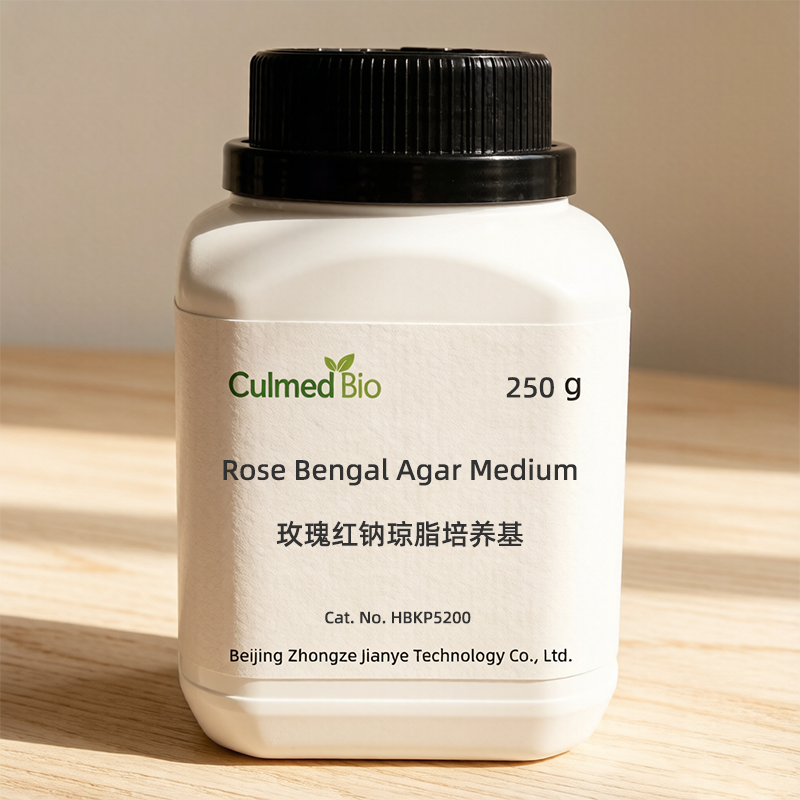
This Rose Bengal Agar Medium is a dehydrated powder formulation designed for the selective isolation and enumeration of molds (molds) and yeasts. It is widely used in food, pharmaceutical, cosmetic, and environmental microbiology for the enumeration of fungal contamination.
The medium is made selective by the inclusion of Rose Bengal sodium (also known as Bengal Rose), a dye that inhibits the growth of most bacteria while allowing fungi to develop. In addition to its selective properties, Rose Bengal also helps to restrict the spreading growth of certain molds, which can otherwise overgrow the plate and make accurate counting difficult. This results in more compact and discrete colonies, facilitating reliable enumeration.
The nutrient base includes peptone for carbon and nitrogen, glucose as an energy source, dipotassium phosphate as a buffer, and magnesium sulfate for essential trace elements. The pH is maintained near neutral, which supports the growth of a wide range of fungi.
Intended Use
- Enumeration of molds and yeasts in food and beverage samples.
- Microbiological testing of pharmaceutical and cosmetic products.
- Environmental monitoring for fungal contamination.
- Quality control in laboratories requiring fungal counts.
- For laboratory use only. Not for clinical diagnosis.
Composition (per Liter)
- Peptone: 5.0 g
- Potassium Dihydrogen Phosphate: 1.0 g
- Rose Bengal Sodium: 0.0133 g
- Magnesium Sulfate: 0.5 g
- Glucose: 10.0 g
- Agar: 14.0 g
- Final pH: Approximately 6.8–7.2 at 25°C (typical for this formulation)
Principle of the Medium
- Peptone: Provides carbon and nitrogen sources for fungal growth.
- Glucose: A readily available energy source that supports fungal development.
- Potassium Dihydrogen Phosphate: Acts as a buffering agent to maintain pH stability.
- Magnesium Sulfate: Supplies essential trace elements for fungal metabolism.
- Rose Bengal Sodium: A selective inhibitory agent that suppresses bacterial growth and restricts the spreading of rapidly growing molds, allowing discrete colonies to form.
- Agar: Solidifying agent.
Storage and Shelf Life
- Format: 250 g/bottle, dehydrated powder.
- Shelf Life: 3 years from date of manufacture.
- Storage: Store in a dry, dark place at 2–8°C. Keep tightly closed to prevent moisture absorption. Protect from light.
Q: What is Rose Bengal Agar used for?
A: It is used for the selective isolation and enumeration of molds and yeasts in food, pharmaceutical, and environmental samples.
Q: How does Rose Bengal work in this medium?
A: Rose Bengal is a selective agent that inhibits bacterial growth and restricts the spreading of rapidly growing molds. This results in more compact, discrete colonies that are easier to count.
Q: Why is Rose Bengal Agar preferred for mold counting?
A: Because it restricts the spreading of mold colonies, it helps prevent one colony from covering the entire plate. This allows for more accurate counting, especially in samples with high fungal loads.
Q: How do I prepare the medium?
A: Weigh 31.5 g of powder, add to 1,000 mL of purified water, heat to boiling until completely dissolved, autoclave at 121°C for 15 minutes, cool to 45–50°C, and pour plates.
Q: What is the shelf life and storage condition?
A: The shelf life is 3 years from the date of manufacture when stored at 2–8°C in a dry, dark place. Protect from light to prevent degradation of the Rose Bengal dye.
Q: Is this medium intended for clinical use?
A: No. This product is intended for laboratory quality control and microbiological testing only. It is not intended for clinical diagnosis.
| Parameter | Specification |
|---|---|
| Product Form | Dehydrated powder |
| Package Size | 250 g/bottle |
| Peptone | 5.0 g/L |
| Potassium Dihydrogen Phosphate | 1.0 g/L |
| Rose Bengal Sodium | 0.0133 g/L |
| Magnesium Sulfate | 0.5 g/L |
| Glucose | 10.0 g/L |
| Agar | 14.0 g/L |
| pH | ~6.8–7.2 (at 25°C) |
| Sterilization | 121°C for 15 minutes |
| Incubation | 20–25°C, 3–5 days |
| Shelf Life | 3 years |
| Storage | 2–8°C, dry, protected from light |
| Intended Use | Mold and yeast enumeration (in vitro) |
