
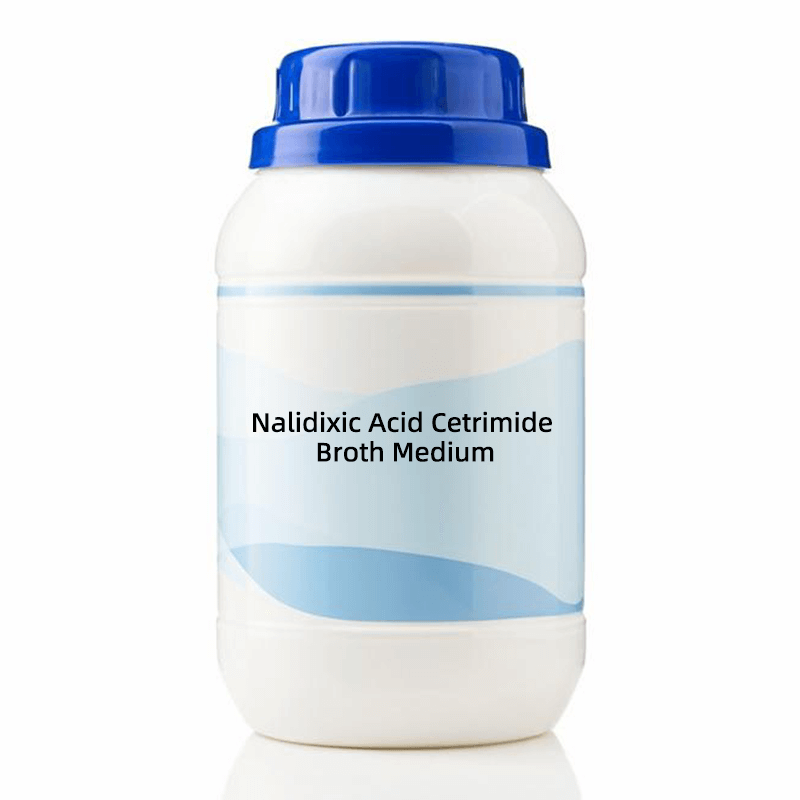
Product Overview
NAC Broth is a microbiological enrichment medium formulated for the selective cultivation and enrichment of Pseudomonas aeruginosa in laboratory testing.
This dehydrated culture medium is widely used in microbiology laboratories for the detection and enrichment of Pseudomonas aeruginosa from environmental, water, and industrial samples. The formulation includes selective components that help suppress competing microorganisms while supporting the growth of the target organism.
The medium is supplied in dehydrated powder form and requires dissolution in purified water followed by sterilization before use.
Product Specifications
| Parameter | Description |
|---|---|
| Product Name | NAC Broth |
| Application | Enrichment culture of Pseudomonas aeruginosa |
| Packaging | 250 g / bottle |
| Storage | Room temperature |
| Shelf Life | 3 years |
| Form | Dehydrated powder |
Applications
NAC Broth is commonly used for:
- Enrichment of Pseudomonas aeruginosa
- Microbiology laboratory testing
- Environmental microbiology monitoring
- Water microbiology analysis
- Industrial microbiology laboratories
- Research and quality control testing
Medium Composition
Peptone
Magnesium Sulfate
Dipotassium Phosphate
Cetrimide
Nalidixic Acid
(Exact formulation prepared according to laboratory preparation instructions.)
Principle
Peptone provides nitrogen sources for microbial growth. Magnesium sulfate and dipotassium phosphate supply essential ions required for microbial metabolism. Cetrimide functions as a selective agent that inhibits non-target bacteria. Nalidixic acid acts as a selective antimicrobial agent that suppresses competing microorganisms.
Preparation Instructions
- Suspend 20.8 g of the medium in 1000 ml distilled or deionized water.
- Heat the mixture until the medium is completely dissolved.
- Dispense the medium into appropriate containers.
- Sterilize by autoclaving at 121°C for 15 minutes.
- Allow the medium to cool before use.
Note:
Because the formulation contains magnesium sulfate, the sterilized medium may appear slightly turbid and small amounts of sediment may be observed.